
Car Financing in Canada: How to Lower Your Monthly Payment over Time
If your car financing no longer reflects your improved credit profile, now may be the right time to explore ways to lower your monthly payment instead of keeping high instalments until the final term.
As income, credit history, and the outstanding balance improve, some borrowers may qualify for new terms or find other ways to reduce financial pressure.
Lowering a payment is useful only when the revised arrangement remains affordable and transparent. Compare your options carefully to reduce costs without extending debt unnecessarily or remaining in negative equity for longer.
Review your car financing before making changes 📄
Begin with the existing agreement and a current payout statement. Record the APR, remaining principal, number of payments left, payment frequency, maturity date, prepayment rules, and charges connected with changing or closing the loan.
Compare the outstanding balance with the vehicle’s current market value. This reveals whether you have positive equity or owe more than the car is worth. Negative equity can restrict refinancing, selling, and trade-in options.
Separate payment relief from real savings 🔍
A lower monthly obligation may result from a better rate, a lower principal, or a longer repayment period. Only the first two normally reduce costs without automatically extending the debt.
Before accepting revised car financing, ask for the new APR, term, payment schedule, fees, cost of borrowing, and total amount payable. Compare those figures with what remains under the current contract.
Improve the credit profile before seeking a refinance 📈
Pay every account on time, reduce avoidable credit-card balances, and check Equifax and TransUnion reports for errors. Stable income and a stronger recent payment record may help the next lender view the application more favourably.
Avoid submitting many unfocused applications. Ask whether a quote uses a soft or hard inquiry, then approach lenders that accept your vehicle’s age, mileage, condition, and current loan-to-value position.
When refinancing may lower the payment 🔄
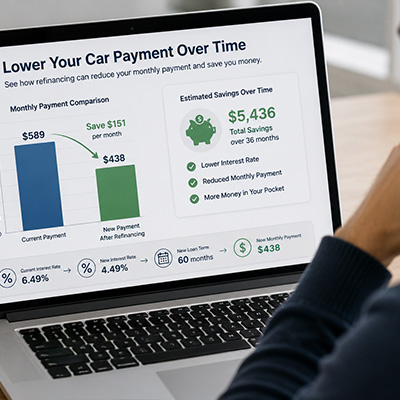
Refinancing replaces the existing loan with a new agreement. It may help when your credit has improved, the new lender offers a lower rate, or the remaining balance supports better terms.
The new car financing proposal should be tested against three outcomes:
- The new monthly or biweekly payment;
- The total interest and fees under the agreement;
- The date on which the vehicle will become debt-free.
A lower rate can reduce the payment and total interest. Extending the term, however, can lower the instalment while raising the eventual cost.
Use principal payments with realistic expectations: car financing 💰
An additional lump sum or extra principal payment can reduce the balance and, depending on the agreement, reduce future interest or shorten the payoff period. It does not necessarily lower the required scheduled payment automatically.
Ask the lender how extra money is applied and whether the loan can be re-amortized. When payment recalculation is unavailable, refinancing after reducing the principal may be the route to a smaller scheduled instalment.
Compare payment-reduction strategies side by side 📊
| Strategy | Possible monthly effect | Main point to verify |
| Lower-rate refinance | Payment may fall | New APR, fees, term, and total payable |
| Longer replacement term | Payment usually falls | Higher interest and negative-equity exposure |
| Lump-sum principal payment | May shorten payoff | Whether scheduled payments are recalculated |
| Trade into a cheaper vehicle | May reduce future debt | Payout balance, trade value, and old debt |
| Lender hardship arrangement | May provide temporary relief | Added interest, fees, reporting, and new dates |
Verified on: June 19, 2026. Availability depends on the lender, contract, borrower, and vehicle.
Be cautious about extending car financing ⚠️
Long-term loans reduce regular payments but increase interest and prolong negative-equity risk. This is especially important when an expensive original loan is replaced with another lengthy agreement.
Do not refinance solely because the payment looks lower. Calculate how many additional months will be added and how much more the vehicle will cost by the final payment.
Review add-ons and payment scheduling 🧾
Check cancellation terms for optional warranties, creditor insurance, or protection products. An eligible refund may reduce the principal, but it may not change the scheduled payment unless the lender recalculates the loan.
Changing a due date or payment frequency can improve cash-flow timing without necessarily reducing the annual amount owed. Confirm the exact effect in writing before authorizing a change.

Contact the lender before a payment is missed for car financing ☎️
When car financing becomes difficult after an income loss or emergency, contact the creditor early. Depending on its policies, it may discuss a lower rate, longer schedule, consolidation, or another temporary arrangement.
Any deferral or extension should be documented. Ask how interest will accrue, whether fees apply, how the arrangement will appear on credit reports, and what payments will be required afterward.
Consider selling or trading only after checking equity 🚘
Trading into a cheaper vehicle may reduce future expenses, but negative equity can be rolled into the next loan and erase the apparent savings. Obtain the current payout amount and several realistic vehicle valuations before negotiating.
Selling privately may produce a better price than a trade-in, but the existing lien must be handled correctly and the lender must confirm how it will release its security interest.
Lower the payment without restarting the debt cycle 🔑
Effective car financing changes should improve cash flow while protecting the total cost and payoff timeline. A lower-rate refinance, reduced principal, or less expensive vehicle can help, but every option requires written calculations.
Compare the old and new agreements line by line. The best adjustment is not merely the smallest payment—it is the one that remains manageable, limits additional interest, and moves you steadily toward owning the vehicle free of debt.
FAQ ❓
Does improving my credit guarantee a lower payment?
• No. Approval also depends on income, debts, vehicle eligibility, equity, and the new lender’s criteria.
Will an extra payment automatically reduce my instalment?
• Not always. It may reduce principal or shorten the loan instead. Ask whether recalculation is available.
Is extending the term a good payment strategy?
• It provides immediate relief but generally increases total interest and may prolong negative equity.
Can optional-product refunds lower the payment?
• A refund may reduce the balance, but the scheduled amount may remain unchanged unless the lender recalculates it.
What should I compare before refinancing?
• Compare the APR, remaining and new terms, fees, payment schedule, total interest, and total amount payable.
