
Learn Auto Loans Renewal and Trade-In Strategies for Canadians
Before making changes to your auto loans, understand how they work after approval so you can choose the option that best supports your long-term financial goals.
They normally continue until the scheduled balance is repaid, unless the borrower pays them out, refinances the debt or replaces the vehicle through a new financing transaction.
For Canadians with damaged credit, the main challenge is avoiding another high-cost cycle. Compare your options carefully by assessing the current payout, vehicle value, replacement rate, new term and total amount payable together before making a decision.
What renewal usually means for auto loans 🔄
In everyday dealership language, “renewal” may refer to refinancing, trading in the vehicle or arranging a new contract near the end of ownership. Each route creates a different financial outcome.
Refinancing auto loans requires a new application and approval. The lender may reassess credit, income, existing debts, recent payment history and the vehicle’s value. A lower regular payment is not automatically a saving if it comes from extending repayment for several more years.
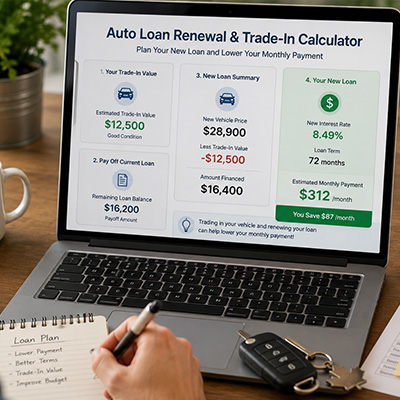
Calculate the payout and equity position first for auto loans 🔍
Request a dated payout statement from the current lender. This shows the amount required to clear the financing and release its security interest. The payout can differ from the balance shown on a previous statement because interest continues to accrue.
Next, obtain realistic trade-in and private-sale estimates. Compare them with the payout:
- Positive equity: the vehicle is worth more than the debt;
- Break-even: the value is close to the payout;
- Negative equity: the debt exceeds the vehicle’s value.
This calculation should be completed before negotiating another car or discussing replacement auto loans.
Why negative equity creates a costly rollover 📉
When a trade-in has negative equity, the shortfall may be added to the new amount financed. The borrower then pays for the replacement vehicle while also paying principal and interest linked to the previous one.
Rolling debt forward can create:
- A larger opening balance;
- A higher payment or longer term;
- More total interest;
- Immediate negative equity in the replacement car;
- Less flexibility to sell or trade again.
Keeping a reliable vehicle longer, paying down the balance or covering part of the shortfall in cash may reduce the rollover. Emergency savings should not be exhausted merely to complete a trade.
Figures that must appear clearly in the auto loans transaction 🧾
The sales and financing documents should allow the borrower to identify each part of the deal.
| Figure or condition | Why it matters |
| Current lender payout | Shows the debt needed to clear the old lien |
| Trade-in allowance | Records the value credited for the vehicle |
| Equity or shortfall | Reveals whether old debt enters the new financing |
| Replacement vehicle price | Establishes the new purchase cost |
| Down payment and fees | Explain adjustments to the financed amount |
| Final amount financed | Shows the total new debt |
| Verification date | 19 June 2026 |
If a dealer agrees to pay the old lender, follow up and confirm that the payout was completed and the lien was discharged.
Compare refinancing with a replacement transaction ⚖️
Refinancing may be useful when the borrower’s credit profile or income has improved enough to qualify for a meaningfully lower rate or total cost. It may be unsuitable when fees or an extended term eliminate the apparent savings.
Replacing the vehicle can make sense when transportation needs change or repair costs are no longer reasonable. However, new taxes, fees, depreciation and optional products can make replacement auto loans more expensive than keeping a dependable car.
Compare:
- Current balance and remaining term;
- Proposed interest rate and term;
- Refinancing or dealer fees;
- Total amount payable;
- Expected maintenance costs;
- Insurance for the replacement vehicle.
How bad credit affects the new offer 📊
A history of missed payments, collections or high balances may lead to a higher rate, a larger down payment or stricter vehicle limits. Recent on-time payments can support the application, but approval and improved pricing are not guaranteed.
Before seeking new auto loans, review both Canadian credit reports, correct genuine errors and reduce revolving balances where practical. Prepare current proof of income and provide accurate housing and debt information.
Trade-in strategies that reduce risk 🛠️
Borrowers can make the transaction safer by:
- Keeping the current vehicle while it remains dependable;
- Making extra principal payments when permitted and affordable;
- Saving gradually to reduce a future shortfall;
- Negotiating the replacement price separately from the trade;
- Comparing direct and dealer-arranged financing;
- Declining optional products that do not provide clear value;
- Avoiding a very long term used only to lower the payment.
Do not sign based only on a monthly or biweekly figure. Review the rate, payment frequency, number of payments, fees and total borrowing cost.
Verify the old lien and the new contract ✅
The final documents should show the trade-in allowance, payout, equity calculation, replacement price and all additions to the financed balance. Verbal promises about clearing the old debt should also appear in writing.
After delivery, contact the former lender to confirm that the old account has been paid. Keep the payout statement, bill of sale, disclosure documents and confirmation of the lien discharge.

Use auto loans without carrying the same debt forward 🚘
The safest strategy is often to keep a reliable car until the balance is closer to its market value. When refinancing or replacement becomes necessary, compare the total cost rather than restarting debt for the smallest advertised payment.
Well-planned auto loans should provide sustainable transportation and a realistic path to repayment. They should not preserve old negative equity through one replacement vehicle after another.
FAQ ❓
Do vehicle loans in Canada automatically renew at maturity?
• Generally, they follow the repayment schedule in the contract. Refinancing or replacement financing normally requires a new agreement.
How do I calculate negative equity?
• Subtract the lender’s payout from the vehicle’s realistic trade-in value. When the result is negative, that amount is the shortfall.
Can a dealer include the shortfall in the new financing?
• It may be added to the new amount, subject to lender approval, but doing so increases the debt and borrowing cost.
Is refinancing worthwhile whenever the payment decreases?
• No. Compare the new rate, fees, term and total amount payable because an extended term may produce a lower payment but a higher total cost.
How can I confirm that the old lien was removed?
• Contact the former lender after the payout and keep written confirmation that the account was paid and the lien discharged.
