
Mitsubishi Outlander specs for the U.S. ES engine, drivetrain and cargo
Mitsubishi Outlander specs identifies the U.S. 2026 turbo powertrain, drivetrain and loading references; match those data to the proposed unit rather than copying the previous model’s engine description.
Begin with model year and drive system, then verify the equipment on the window sticker. The Nissan Rogue trim comparison helps organize passenger priorities, while a visit with luggage shows whether the required seats and usable storage fit your household.
Reading Mitsubishi Outlander specs with the right powertrain 🔧
The 2026 gasoline SUV uses a turbocharged four-cylinder engine supported by a mild-hybrid system. Its output is 174 hp at 6,000 rpm and 206 lb-ft at 3,000–4,000 rpm. These are manufacturer specifications, not results from an independent road test.
Use Mitsubishi Outlander specs to distinguish power from torque. Horsepower describes one aspect of output, while torque and its engine-speed reference help describe the engine’s operating characteristics. Neither figure establishes acceleration with your passengers, cargo and road conditions, which should be evaluated on a suitable demonstration drive.
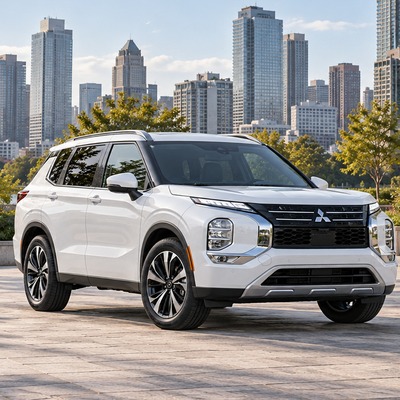
Read Mitsubishi Outlander specs without confusing CVT ratios ⚙️
Mitsubishi lists an eight-speed continuously variable transmission. In this application, the ratios are simulated steps within a CVT rather than evidence of an ordinary eight-speed automatic gearbox. Paddle shifters let the driver select the programmed behavior described by the manufacturer.
A CVT’s response may feel different from the gearbox in your current vehicle. Check smoothness when starting, maneuvering and accelerating onto a highway. Assess the actual vehicle under normal driving conditions; a spec sheet cannot establish whether that response suits your preferences.
Where Mitsubishi Outlander specs affect passenger and luggage use 🧳
Seven seats describe passenger capacity, not the amount of luggage that fits with every seat occupied. The ES example has a 309-litre cargo reference behind the third row and a much larger maximum with rear seating folded. Those arrangements serve different tasks.
When applying Mitsubishi Outlander specs, consider your usual passenger count first. The Nissan Rogue passenger-layout comparison for a different crossover supports a separate seating discussion. A third row that helps occasionally may still be inconvenient when you routinely need substantial cargo space and easy access at the same time.
Measurements to check during a vehicle visit 📏
Bring the objects that usually travel with you or note their measurements. Confirm the arrangement that accommodates them without interfering with passengers, seat belts or visibility, rather than relying on a maximum-volume claim alone.
- Third row: passenger access and the remaining luggage area.
- Second row: room with the driver’s seat in its normal position.
- Cargo opening: usable width and height for bulky items.
- Parking: overall footprint and clearance around the vehicle.
- Load label: permitted weight for people and belongings.
Separating drivetrain figures from equipment choices 📊
The published EPA numbers differ between two-wheel drive and S-AWC. Both figures use the same U.S. methodology, so they can support a comparison. They cannot be transferred directly to a plug-in hybrid measurement or to a result obtained in another country.
Choose S-AWC for its actual traction function and your driving environment. The discussion of Silverado RST usage and ownership costs for a pickup illustrates a different usage decision; its running costs do not apply here. Tires, climate, traffic and load still affect the mileage obtained from either Outlander drivetrain.
Published 2026 drivetrain references ⛽
| Gasoline configuration | EPA city / highway / combined | Reading the result |
|---|---|---|
| 2WD | 26 / 31 / 28 mpg | Front-wheel-drive comparison reference |
| S-AWC | 26 / 30 / 27 mpg | All-wheel-control comparison reference |
The highway and combined figures differ by one mpg. That difference should be considered alongside your traction needs, with the understanding that these are standardized labels. A short test drive or a favorable highway segment does not establish annual fuel savings.
Additional ES 2WD technical reference 🚙
| Specification | U.S. 2026 Outlander ES 2WD |
|---|---|
| Powertrain | 1.5L turbo, four-cylinder, mild hybrid |
| Output / torque | 174 hp at 6,000 rpm / 206 lb-ft at 3,000–4,000 rpm |
| Transmission / drive | CVT with eight simulated ratios / front-wheel drive |
| EPA city / highway / combined | 26 / 31 / 28 mpg |
| Length / height | 185.8 / 68.7 inches; approximately 4,719 / 1,745 mm |
| Width, mirrors folded / unfolded | 74.7 / 84.4 inches |
| Wheelbase | 2,705 mm |
| Curb weight | 3,770 lb |
| Seating / fuel tank | Seven / 14.5 U.S. gallons |
| SAE cargo behind third row / front seats | 10.9 / 64.3 cu ft; approximately 309 / 1,821 litres |
The wheelbase helps describe the vehicle’s footprint, while the cargo figures depend on seat position. Curb weight is not payload, so do not subtract or add luggage using it as a loading allowance. Read the specific vehicle’s load label before planning a heavily occupied trip.
Match Mitsubishi Outlander specs to the documented vehicle ✅
Apply Mitsubishi Outlander specs to a unit with engine, drivetrain and equipment confirmed. Test parking, passenger access and loading rather than treating output or maximum cargo as a complete answer.
Keep the window sticker and have essential features identified in the written quote. Distinguish optional packages from standard equipment. If the vehicle changes, repeat those checks so an older description or promotional photograph does not decide the configuration delivered.
FAQ ❓
1. Which engine does the 2026 gasoline SUV use?
- A 1.5L turbo mild-hybrid four-cylinder, separate from the PHEV powertrain.
2. Does the CVT have eight ordinary fixed gears?
- Its published eight-speed description refers to programmed ratios within a continuously variable transmission.
3. What should I measure for a bulky item?
- Check the cargo opening and usable space with the passenger rows in their intended position.
4. Which drivetrain has a 28-mpg combined reference?
- The 2026 two-wheel-drive configuration; S-AWC is rated at 27 combined mpg.
5. Where can I compare current U.S. configurations?
- Use Mitsubishi’s specification page with the selected trim and drivetrain.
