
Artificial Intelligence Stock Market Prediction: Practical Playbook to Analyze Trends and Make Smarter Trades
Start applying artificial intelligence stock market prediction today to analyze trends, filter noise, and build a more efficient portfolio with confidence.
The surge of AI has changed how investors interpret markets, shifting from intuition-heavy decisions to data-first strategies.
With AI, you can scan thousands of signals in seconds, spot patterns earlier, and act with more precision.
Discover how to eliminate high-interest debt faster and build a stronger financial future with personal loan lenders online decisions.
Build a foundation for artificial intelligence stock market prediction 🧠📊
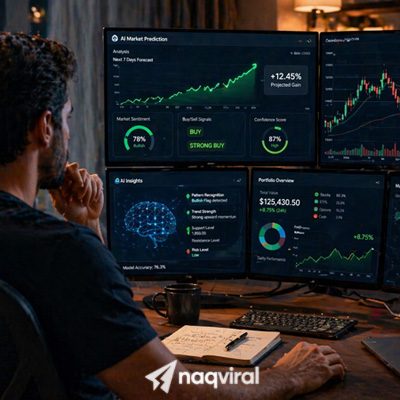
To use AI effectively, you need a solid foundation in how data flows into models and how outputs should be interpreted.
AI does not replace thinking—it amplifies it.
Start by understanding inputs: price history, volume, volatility, macro indicators, and sentiment.
Then, map how models transform these inputs into signals such as trend direction, probability scores, or anomaly alerts.
The goal is to translate model output into clear actions without overcomplicating decisions.

Choose the right tools 🛠️🤖
Selecting tools is critical because different platforms excel at different tasks within artificial intelligence stock market prediction. Your stack should balance usability, depth, and cost.
Key tool categories to evaluate:
- Signal platforms (AI indicators, alerts, screeners)
- Backtesting tools to validate strategies historically
- Data providers for fundamentals and sentiment
- Automation layers for executing rules-based trades
Popular combinations include TradingView (AI indicators) + a data API + a broker with automation support. The objective is a cohesive workflow from signal to execution.
Understand model types used in artificial intelligence stock market prediction 🤓🔬
Different models serve different purposes within AI, and knowing when to use each one increases accuracy.
Supervised models learn from labeled data to predict outcomes like next-day direction or probability of breakout.
They are effective for short-to-medium horizon signals when trained on clean datasets.
Neural networks capture nonlinear relationships and multi-factor interactions. They shine in environments with high-dimensional data, including intraday patterns and cross-asset signals.
Natural language processing extracts sentiment from news, earnings calls, and social media. It helps anticipate reaction-driven volatility and identify catalysts before price fully reflects them.
Apply artificial intelligence stock market prediction in a real workflow ⚙️🚀
A practical workflow turns AI into consistent decisions rather than occasional guesses.
- Scan: Use AI screeners to shortlist assets with strong signals
- Confirm: Validate with a second model or complementary indicator
- Contextualize: Check macro news and earnings calendar
- Plan: Define entry, stop-loss, and take-profit levels
- Execute: Place trades with predefined rules
- Review: Log outcomes and refine parameters
This structure enforces discipline and reduces impulsive trading.
Risk management with artificial intelligence stock market prediction 🛡️📉
Even the best AI cannot eliminate risk. Strong risk management converts good signals into sustainable results.
Core rules to implement:
- Position sizing based on volatility and account size
- Hard stop-losses to cap downside
- Diversification across sectors and strategies
- Max daily/weekly loss limits to avoid spirals
Treat AI signals as probabilities, not certainties—and manage exposure accordingly.
Evaluate performance and avoid overfitting 📏🔍
Performance tracking is essential in artificial intelligence stock market prediction. Without rigorous evaluation, it’s easy to trust models that only worked in the past.
- Win rate vs risk-reward ratio
- Sharpe ratio and drawdown
- Consistency across market regimes
- Out-of-sample validation results
Red flags to watch 🚩⚠️
- Unrealistically high backtest returns
- Performance collapsing in live trading
- Excessive parameter tuning (overfitting)
Robust models perform reasonably well across different conditions, not just perfectly in one dataset.
Cost, fees, and hidden frictions in AI trading 💸🔧
Using AI involves costs that can erode returns if ignored.
Common frictions:
- Data subscriptions and API fees
- Platform and automation costs
- Slippage and spreads in execution
- Tax implications on frequent trading
Build a sustainable system 🔄🌱
Long-term success with AI comes from consistency and iteration. Create a system you can follow even during volatility.
Best practices:
- Keep a trading journal with signal source and rationale
- Review weekly to adjust rules, not impulses
- Limit the number of strategies to avoid dilution
- Automate repetitive tasks to reduce errors
A sustainable system converts short-term wins into long-term edge.
Discover auto financing Ally credit tactics, and negotiation angles that cut thousands from your total cost.
Where artificial intelligence stock market prediction is heading next 🌐✨
The next phase of artificial intelligence stock market prediction includes real-time personalization, cross-asset intelligence, and deeper integration with execution platforms.
Expect smarter copilots that adapt to your style, tighter feedback loops, and better risk dashboards.
As tools evolve, the advantage will belong to investors who combine technology with discipline, not those who chase signals blindly.
FAQ ❓
- Can AI replace human judgment in trading?
- No, AI enhances analysis, but human oversight is essential for context and risk control.
- What timeframe works best with AI signals?
- It depends on the model, but short-to-medium horizons often benefit most from AI insights.
- Do I need coding skills to use AI tools?
- Not necessarily; many platforms are user-friendly, though coding can expand capabilities.
- How much capital is required to start?
- It varies; you can start small, but risk management matters more than account size.
- Is backtesting enough to trust a strategy?
- No, always validate with out-of-sample tests and cautious live deployment.
