
Jeep Grand Cherokee 2026 powertrain options compared
Jeep Grand Cherokee 2026 offers three distinct powertrains, and the differences between them are far larger than the trim names suggest.
The familiar 3.6-litre Pentastar V6 continues as the standard engine on the entry tier, producing 293 horsepower and 260 pound-feet through an eight-speed automatic.
Alongside it, a newly introduced turbocharged four-cylinder and an established plug-in hybrid give buyers three genuinely different ownership propositions within the same body. Output, efficiency, complexity and purchase price all move independently across the three.
What the new turbo four brings to the Jeep Grand Cherokee 2026 ⚙️
The 2.0-litre Hurricane4 inline-four is the headline mechanical addition. It produces 324 horsepower and 332 pound-feet using turbulent jet ignition combustion technology, paired with a new eight-speed transmission. That is 31 more horsepower and 72 more pound-feet than the naturally aspirated six it sits above.
Efficiency is where the case becomes compelling. The turbocharged engine is rated at 21 mpg in the city, 27 on the highway and 23 combined, with a driving range of 506 miles. For a Jeep Grand Cherokee 2026 buyer covering long distances, that combination of more torque and fewer stops is the practical argument for the smaller engine.
Where the plug-in hybrid fits in the Jeep Grand Cherokee 2026 range 🔌
The 4xe plug-in hybrid pairs a 2.0-litre turbocharged engine with dual electric motors for 375 horsepower and 470 pound-feet, and a total range of 470 miles. It is offered on the Limited, Summit and Trailhawk tiers, and it is the only path to the dedicated off-road configuration.
- Estimate what share of your daily driving would fall within electric-only operation.
- Confirm whether you have dependable charging access at home or at work.
- Compare the purchase premium against realistic annual fuel savings for your mileage.
- Check high-voltage battery warranty terms and local service availability.
Torque delivery versus peak horsepower 📈
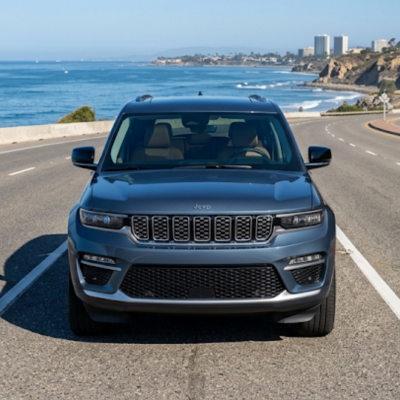
The plug-in hybrid’s 470 pound-feet is the highest figure in the range, and electric motors deliver torque immediately rather than building it with engine speed. That produces effortless acceleration from a standstill and confident merging, characteristics that matter more in daily driving than the difference in peak horsepower between the three options.
When the naturally aspirated six still makes sense 🔧
The Pentastar V6 remains the simplest option mechanically, with no turbocharger and no high-voltage system. For buyers who prioritise straightforward maintenance, lower purchase price and a long service history, it remains a defensible choice despite being outperformed on both output and efficiency by the newer turbocharged engine.
What charging access changes 🔋
A plug-in hybrid returns its premium only when the battery is regularly replenished from an outlet. Without that, it operates largely as a conventional hybrid while carrying the weight and complexity of the battery pack. Buyers without reliable charging should compare the turbocharged four against the hybrid on real-world terms before paying the difference.
Comparing the three on the numbers 📊
Ranked by output, the plug-in hybrid leads, the turbocharged four sits in the middle and the naturally aspirated six trails. Ranked by mechanical simplicity, the order reverses completely. Ranked by cost of entry, the six is lowest and the hybrid highest.
No Jeep Grand Cherokee 2026 powertrain wins on every axis, which is why the decision has to start from driving patterns rather than from specification sheets. Annual mileage, the split between city and highway travel, and charging access determine which of the three actually costs least to live with.
Powertrain comparison table 📋
| Powertrain | Output | Efficiency and range | Availability |
| 3.6L Pentastar V6 | 293 hp and 260 lb-ft | Not detailed for this configuration | Standard on the entry tier |
| 2.0L Hurricane4 turbo | 324 hp and 332 lb-ft | 21 city, 27 highway, 23 combined mpg; 506-mile range | Newly introduced for this model year |
| 4xe plug-in hybrid | 375 hp and 470 lb-ft | 470-mile total range | Limited, Summit and Trailhawk tiers |
The table makes the trade explicit. The turbocharged four beats the six on both output and efficiency, while the plug-in hybrid leads on torque and offers electric operation, at the cost of complexity, purchase price and dependence on charging infrastructure.
Ownership factors to weigh ⚠️
Turbocharged engines require disciplined oil-change intervals and specified oil grades. High-voltage systems require certified service and add weight that affects tire wear. Towing ratings and payload figures vary by powertrain and configuration, so they should be confirmed for the exact vehicle rather than taken from a range-wide maximum.
Choosing an engine by how you actually drive 🎯
Selecting a powertrain for a Jeep Grand Cherokee 2026 comes down to three questions: how many miles you cover annually, how those miles split between city and highway, and whether you can charge reliably. High-mileage highway drivers are well served by the turbocharged four; buyers with short commutes and home charging benefit most from the plug-in hybrid; those prioritising simplicity and lower entry cost still have the six.
FAQ ❓
- How many powertrains are offered?
- Three: a naturally aspirated V6, a new turbocharged four-cylinder and a plug-in hybrid.
- Which option produces the most torque?
- The plug-in hybrid, at 470 pound-feet, ahead of both combustion-only engines.
- Is the new turbocharged engine more efficient than the V6?
- It is rated at 23 mpg combined with a 506-mile range, alongside higher output than the six.
- Which tiers offer the plug-in hybrid?
- The Limited, Summit and Trailhawk tiers of the current lineup.
- Where can these figures be confirmed?
