
Private Sale Car Loan vs Dealer Financing in Canada
If you’re considering a private sale car loan, compare your financing options before committing so you can choose a vehicle with greater confidence. A private sale car loan may help you purchase directly from an individual, potentially giving you more choice over the vehicle and purchase price.
However, financing, inspection, ownership transfer, and lien checks often require more coordination than they would at a registered dealership.
Before signing any agreement, review the total loan cost and confirm the vehicle meets lender requirements to make a more informed decision. For drivers rebuilding credit, the safest decision depends on the total borrowing cost, vehicle condition, lender requirements, and consumer protections—not simply where the car is advertised.
How a private sale car loan works in Canada 🤝
A lender must usually approve both the borrower and the selected vehicle. It may request the bill of sale, VIN, registration details, seller information, proof of insurance, valuation, inspection, and evidence that no unresolved lien will remain after the transaction.
A private sale car loan may be arranged through a bank, credit union, or another lender that accepts person-to-person purchases. Requirements differ, so confirm vehicle age, mileage, condition, value, and seller rules before paying a deposit.
Extra checks required in a private transaction 🔍
The buyer—not a dealership sales team—must coordinate many parts of the purchase. Before transferring money:
- Match the VIN on the vehicle, registration, and bill of sale;
- Confirm the seller’s identity and legal ownership;
- Obtain an independent mechanical inspection;
- Review available maintenance and accident history;
- Search for registered liens using the appropriate provincial or territorial system;
- Confirm taxes, registration, safety, and transfer requirements locally.
Some jurisdictions require specific used-vehicle information from private sellers. Rules vary, so check the transportation and consumer-protection authorities where the vehicle will be registered.
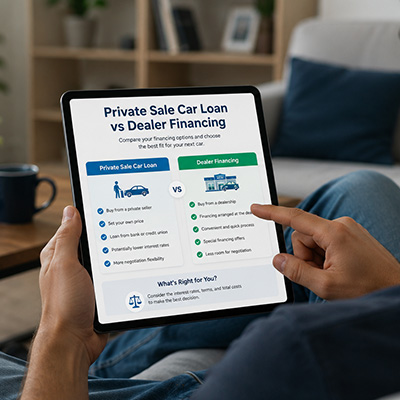
How dealership financing changes the process for private sale car loan 🚘
A registered dealer can arrange financing through a manufacturer, bank, credit union, or independent finance company. The dealer may handle more paperwork, vehicle-history disclosure, registration steps, and lender communication.
This convenience does not guarantee the lowest cost. Ask the dealer to identify the lender, disclose the APR, term, fees, add-ons, total amount payable, and any other approvals received. Negotiate the vehicle price separately from the financing.
Convenience and protections at a dealership 🛡️
Consumer protections for registered dealers vary by province or territory, but they are generally more structured than those applying to an ordinary private seller. A dealer may also provide access to several lenders, which can help applicants with damaged credit.
Still, check for:
- Optional warranties or insurance added to the balance;
- Dealer administration or documentation charges;
- Negative equity carried from a trade-in;
- A repayment term extended mainly to reduce the displayed payment;
- Conditions that differ from the verbal explanation.

Compare a private sale car loan with dealer financing 📊
Use the same vehicle budget, down payment, and repayment horizon when comparing offers. A private purchase price may be lower, but inspection, immediate repairs, registration costs, and financing restrictions can narrow the apparent savings.
| Comparison point | Private sale | Registered dealership |
| Vehicle price | Negotiated directly with the owner | Negotiated with the dealer |
| Financing access | Limited to lenders accepting private purchases | Dealer may submit to multiple lenders |
| Vehicle checks | Buyer coordinates inspection and history review | Dealer disclosures vary by jurisdiction |
| Lien review | Buyer must verify and ensure removal | Registered dealers must meet local obligations |
| Consumer recourse | Usually more limited | Provincial dealer protections may apply |
| Main decision | Verify car, seller, loan, and transfer | Verify price, lender, fees, and add-ons |
Verified on: June 19, 2026. Financing and purchase requirements vary by lender, province, territory, seller, and vehicle.
Protect the transaction from liens and fraud ⚠️
A lien is a registered claim against a vehicle. If the seller still owes money, the lender’s interest may remain attached to the car. Request written proof that any debt has been paid and the registration removed before completing the purchase.
The private sale car loan should not be finalized until the lender accepts the vehicle and the ownership path is clear. Avoid cash-only pressure, mismatched names, missing documents, altered VINs, or requests to send money before inspecting the car.
Documents to organize before approval 📁
Prepare government-issued identification, proof of address, income records, employment details, down-payment evidence, insurance information, and any lender-requested bank statements. For the vehicle, gather the VIN, bill of sale, registration, lien results, history report, valuation, and inspection.
Organized documents can reduce delays, but they do not guarantee approval. The lender may still change or withdraw a conditional offer after reviewing the vehicle.
Judge both options by total borrowing cost: private sale car loan vs dealer financing 💰
For each private sale car loan or dealer proposal, compare the APR, amount financed, payment frequency, term, fees, optional products, prepayment rules, cost of borrowing, and total amount payable.
A lower instalment may hide a longer term and more interest. Also budget for insurance, fuel, maintenance, winter tires, registration, and repairs—especially when buying an older vehicle without dealer-backed coverage.
Choose the safer structure for your circumstances 🔑
A dealership may be stronger when you value coordinated paperwork, structured consumer protections, and access to several lenders. A private purchase may fit when the vehicle passes independent checks and the written financing offer produces a better complete cost.
Before signing a private sale car loan, confirm that the lender, seller, vehicle, lien status, insurance, and transfer documents all align. The best route is the one that delivers reliable transportation without turning damaged credit into a larger financial problem.
FAQ ❓
Can I finance a vehicle bought from a private seller?
• Yes, when a lender accepts private purchases and approves both your application and the selected vehicle.
Does a private seller provide the same protections as a dealer?
• Generally not. Dealer protections and disclosure duties vary by jurisdiction, while private buyers must complete more independent checks.
How do I check whether the car has a lien?
• Use the appropriate provincial or territorial personal-property search and consider a reputable vehicle-history report.
Is dealership financing always more expensive?
• No. Compare the actual APR, term, fees, add-ons, and total amount payable for both options.
What should happen before I send money to a private seller?
• Verify ownership, VIN, lien status, vehicle condition, signed documents, lender approval, insurance, and the legal transfer process.
